

AI Assistant for Water and Wastewater Network Management
 Delta is an AI assistant built on top of your water or wastewater network. It translates the structural knowledge locked inside that model — topology, flow estimates, risk scores, telemetry — into direct, conversational answers.
Ask about a pressure zone, a failing asset, a catchment with elevated infiltration, or the consequence of a planned intervention. Delta returns a reasoned answer grounded in your actual network data — not generic hydraulic knowledge.
No calibrated hydraulic model required. Delta delivers flow estimates and fault context using graph algorithms across pipe topology — removing the single biggest barrier to AI adoption in water utilities.
"The LLM is the reasoning layer. The network model is the knowledge base. Neither is sufficient without the other."
Telemetry, Risk Scores, and Graph-Based Hydraulics — No New Data Collection Required
Answers are composed from multiple data layers that PipeFusion already holds. No new data collection is required — the reasoning layer sits on top of existing water utility asset management models.
Predictive Maintenance, Rehabilitation Prioritisation, and Inflow & Infiltration Analysis
Delta's scope is deliberately bounded to areas where InfoTiles data provides genuine depth. Capabilities outside this scope are not surfaced.
Query risk scores, explain the drivers behind a specific segment's ranking, and compare candidate assets for intervention sequencing.
Generate cost-ranked intervention lists from risk data and rehabilitation method costs, with transparent methodology.
Surface hydraulic context around an active alarm — upstream topology, adjacent risk scores, recent telemetry — without manual correlation.
Combine SewerIntelligence I&I telemetry with PipeFusion risk scores to prioritise CCTV inspection plans, structured and ranked.
Decision Support in Action: I&I Inspection Prioritisation Using Live Network Data
The example below is an actual prompt run against a utility network. Delta combines SewerIntelligence I&I telemetry with PipeFusion risk scores to generate a prioritised CCTV inspection plan — structured, ranked, and ready to act on.

What Water and Wastewater Utility Teams Say
"We went through the solution with our IT department, and they were impressed by how InfoTiles handled data security. Everything runs within Microsoft, no data leaves the system, and nothing is used for model training."
"The AI assistant does the same calculations that would take me two days and digging around in the database to find."
"If you are wondering about something, you can actually ask follow-up questions."
"It will find the same thing I find, just much faster."
How Delta Works: Retrieval-Augmented Generation on Your Network Model
Delta uses a retrieval-augmented generation (RAG) approach. At query time, relevant segments from the network model, risk scores, and reference documentation are retrieved and injected into the LLM context. The model does not retain state between sessions and is not fine-tuned on customer data.
Infrastructure: Microsoft Azure AI Foundry, EU-hosted, stateless inference, no training on customer data. The LLM is replaceable; the retrieval and context construction pipeline is where the domain specificity lives.
Human-in-the-loop is embedded at the formal recommendation layer. Delta surfaces evidence and methodology; decisions requiring sign-off remain with the operator or asset manager. This is a design principle, not a disclaimer.
EU-Hosted, NIS2-Aligned, and Built for Critical Infrastructure Procurement
Delta is Norwegian-built and operated. For utilities managing critical infrastructure, this matters structurally.
Runs on Microsoft Azure AI Foundry within EU/EEA regions, under standard EU/EEA data processing agreements.
Each session is independent. Nothing persists beyond the session boundary. No customer data is used for model training.
Designed to operate within NIS2 and applicable Norwegian security legislation. Access controls and retrieval pipelines are built to satisfy procurement requirements, not added after the fact.
Why Delta — The Symbol of Change in Water Networks
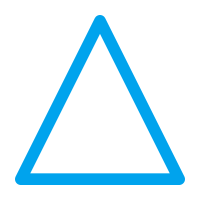
Δ is the mathematical symbol for change — the measured difference between one state and the next. In water networks, that difference is the signal: a pressure anomaly, a flow deviation, a demand shift. Delta surfaces it in plain language, in seconds.
The name carries additional resonance. In hydrology, a delta is where flows converge and are understood — where a network meets the wider world. And like the Norse varder, the stone cairns built on high ground so those who follow always know where they stand, Delta assembles accumulated knowledge and passes it forward.
Delta Is Live with Norwegian Water Utilities, International Rollout Underway
Delta is now in production with Norwegian water utilities as the first wave. Expansion to further markets is underway.
See Delta running against your network data.